
Ways to Nurture a Love of Reading at Home
Most advice on raising a reader stops at "share books together and let them choose." That's true, and it matters. But it only tells half the story. Somewhere between choosing a book and actually being able to read it, there's a skill to build too, and that part can feel like play too, if you approach it the right way.
We're not chasing reading levels in this house. We're trying to make books feel like the best part of the day, while quietly building the skills that get a child there. Here's how we do both.
Start with the relationship
Before any of the phonics, the sounding out, the blending, comes something simpler: does your child want to pick up a book? That question matters and it's built in small, unhurried moments.
We make time for books every day. Not a scheduled lesson, just a slot that's protected, before bed, after lunch, whenever suits your rhythm. It doesn't need to be long. It needs to happen often enough that books become part of the furniture of the day rather than an extra task to fit in.
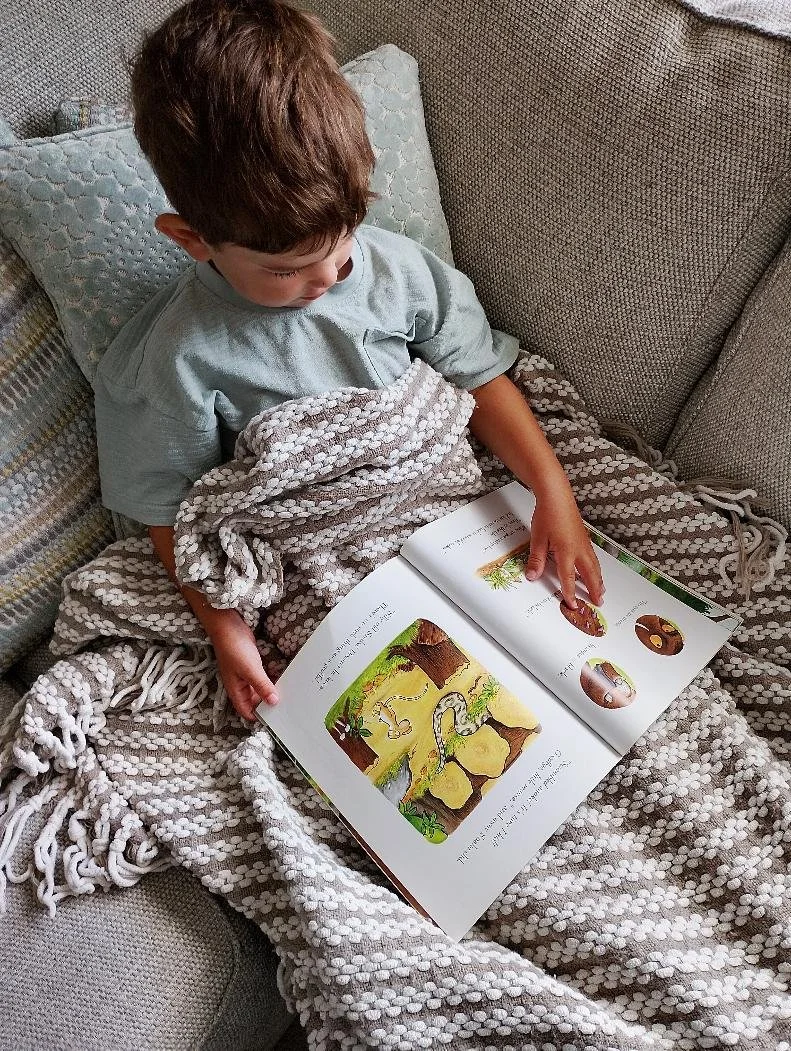
He always picks what we read together. This one is easy to underestimate. Letting your child choose, even if it's the same book every single night, hands them ownership over the experience. A child who picks the story is a child who's already engaged before the book even opens. Variety can wait. Enthusiasm can't be manufactured.
We visit the local library regularly. A library trip does something a shelf at home can't, it turns reading into an outing, an event, a small adventure with its own excitement. It also means the book pile keeps refreshing itself without you having to think about it, and your child gets used to browsing and choosing for themselves.
We keep books visible around the house. Not tidied away in a box, but out, within reach, on a low shelf or a basket by the sofa. A book your child can see and grab without asking is a book far more likely to be picked up in a spare five minutes.
And if he's not interested, we come back to it later. Never force it. Some days the mood just isn't there, and that's fine. Reading pushed against resistance teaches a child to resent it. Reading offered gently and often, with no pressure attached, teaches them to want it.
None of this needs a plan. It needs time, and no pressure attached to it.
When to start teaching letter sounds?
As you build this love of reading, you might start to notice your child becoming curious about the text itself, pointing to a letter, asking what a word says, trying to sound something out unprompted. That curiosity is a great cue. It's a natural moment to start introducing letter sounds, in a low pressure, playful way that protects the positive relationship with books you've already built. It only takes turning it into something your child would choose to do anyway, the same instinct behind letting them pick their own book.
Two simple ways to bring this in. Pick a sound for the day, then hide a handful of objects around the room or garden that all start with it and send your child off to find them, part treasure hunt, part sound practice, and it works absolutely anywhere. Or take it outside and go for a sound walk. Choose a sound before you set off and spot things along the way that start with it, a stone, a slide, a squirrel, no materials needed beyond a walk you were probably taking anyway. Both turn a few minutes of the day into practice without your child ever clocking it as one.
Why both matter together
A child who loves books but never gets playful practice with sounds can find the mechanics of reading frustrating when they are formally introduced. A child who gets plenty of phonics practice but no joy in the books themselves can learn to read and still not choose to. The two need to grow side by side.
The bottom line
Nurturing a love of reading isn't just about story time, and it isn't just about sounding out words either. Make time for books every day, let your child choose, and fold in a little playful sound practice along the way. The rest follows.
Play-based early reading activities designed to build real skills through games your child will ask to play again. Low prep, low pressure, just play. From letter sounds through to reading full sentences.